HPL Results
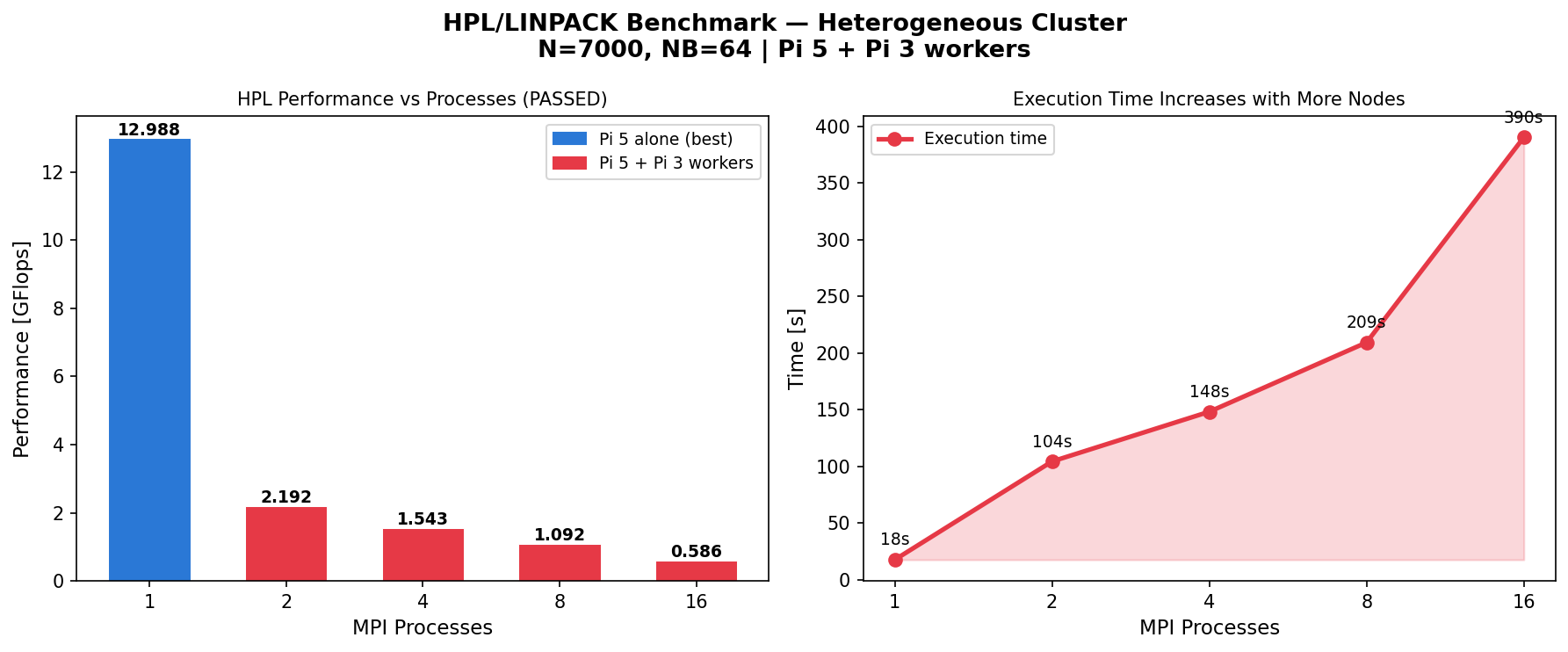
HPL/LINPACK Benchmark — Strong Scaling
Configuration: N=7000, NB=64, P=1, Q=np
| Processes | GFlops | Time (s) | Status |
|---|---|---|---|
| 1 | 12.988 | 17.61 | ✅ PASSED |
| 2 | 2.192 | 104.37 | ✅ PASSED |
| 4 | 1.543 | 148.27 | ✅ PASSED |
| 8 | 1.092 | 209.40 | ✅ PASSED |
| 16 | 0.586 | 390.48 | ✅ PASSED |
| 28 | 0.355 | 643.96 | ❌ FAILED |
Key Observations: - Pi 5 alone (np=1) achieves 12.988 GFlops — by far the best performance - Adding Pi 3 workers consistently DECREASES performance - Performance drops monotonically with more nodes - np=28 fails the residual check — numerical instability with Q=28 process grid
Conclusion: HPL results show the dramatic effect of hardware heterogeneity. The Pi 5 (Cortex-A76 @ 2.4GHz, 8GB LPDDR4X) is approximately 3-4× faster than Pi 3 workers (Cortex-A53 @ 1.2GHz, 1GB LPDDR2). In distributed HPL, the slowest node determines the pace of all others — a classic bottleneck effect. The communication overhead of MPI collective operations (broadcast, all-reduce) over Gigabit Ethernet adds latency at every step. For heterogeneous clusters like ours, HPL is best run on the fastest node alone.
Why does performance drop so dramatically? HPL requires O(n²) communication per O(n³/p) computation. As p increases, the computation per node decreases but communication stays constant, making communication the dominant factor. This is a fundamental limitation of dense linear algebra on distributed memory systems.